


Honolulu's Better Buildings Benchmarking Program (Ordinance 22-17) requires buildings 25,000 square feet or larger to report annual energy and water use through ENERGY STAR Portfolio Manager, with penalties up to $5,000 per year for noncompliance. This guide covers deadlines and strategies.
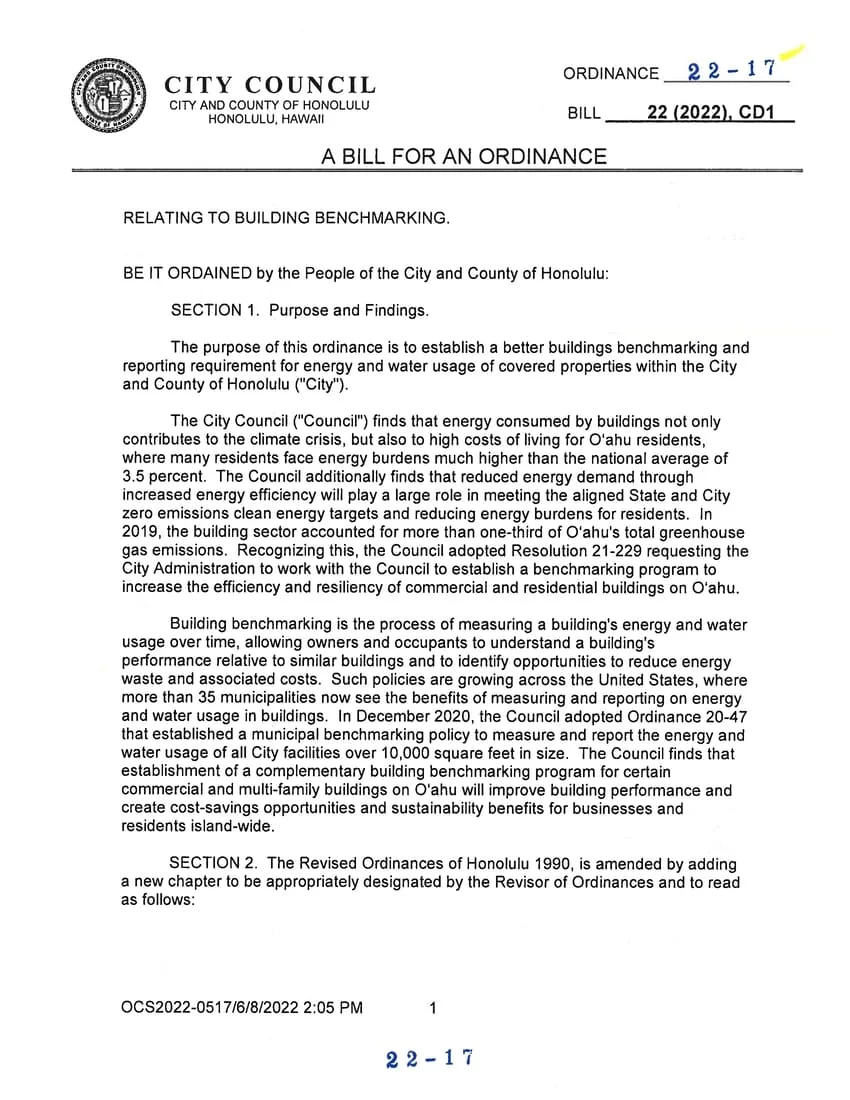
Honolulu has established itself as a leader in energy efficiency and climate action through the Better Buildings Benchmarking Program, enacted under Ordinance 22-17. Signed into law by Mayor Blangiardi on July 20, 2022, this program requires large commercial and multifamily buildings across Oahu to benchmark and report their energy and water consumption annually.
The program is a cornerstone of the City and County of Honolulu's Climate Action Plan, which targets net negative emissions by 2045. With the building sector accounting for roughly one-third of Oahu's total greenhouse gas emissions, benchmarking is expected to reduce electricity consumption in large buildings by nearly 7% by 2030.
For businesses operating in Honolulu, understanding and preparing for these requirements is essential to avoid penalties and contribute to the island's sustainable future.
The Better Buildings Benchmarking Program mandates that owners of large commercial and multifamily buildings track and report their whole-building electricity, gas, and water usage annually through ENERGY STAR Portfolio Manager. Unlike voluntary energy efficiency initiatives, this is a mandatory compliance program with enforcement mechanisms.
Honolulu implemented a phased approach to give building owners time to prepare:
Building owners must report 12 calendar months of whole-building data. For example, in 2025, owners must report their 2024 utility consumption data.
The ordinance applies to a wide range of property types across Oahu:
Property owners can check the City's Covered Buildings List to verify if their building is included and obtain their unique Oahu Building ID for reporting.
Your building may qualify for an exemption if:
Building owners seeking exemptions must complete an Exemption Request Form with supporting documentation.
The Director of Planning and Permitting may issue a notice of order requiring compliance and impose the following penalties:
Additionally, knowingly submitting false benchmarking reports or data is punishable by a $500 fine plus prosecution costs.
Check the City's Covered Buildings List to confirm whether your property is subject to the ordinance and obtain your Oahu Building ID.
Create an account in ENERGY STAR Portfolio Manager, the required platform for submitting benchmarking data. Input your building characteristics including gross floor area, building use type, year built, and operating hours.
Collect 12 months of utility consumption data for electricity, natural gas, water, district energy (if applicable), and any other purchased fuels. Contact your utility providers to obtain historical consumption records.
Manual data collection is time-consuming and error-prone. IoT-based wireless energy monitoring systems provide real-time visibility into building performance, automate data collection, and ensure accurate reporting. Advanced energy management platforms can integrate directly with ENERGY STAR Portfolio Manager, streamlining the compliance process.
Ensure all required data is submitted by the applicable deadline. Calendar year 2024 data must be submitted by September 30, 2025 for buildings 25,000 square feet and larger.
Honolulu's benchmarking program supports Hawaii's broader sustainability objectives:
By benchmarking energy performance, building owners contribute to these goals while gaining actionable insights to reduce consumption and costs.
Buildings that benchmark their energy use consistently identify opportunities for efficiency improvements. Studies show that benchmarked buildings reduce energy consumption by 2-3% annually through awareness alone, with greater savings when paired with efficiency upgrades.
Energy-efficient buildings command premium rents and higher property values. Transparent energy performance data attracts environmentally conscious tenants and investors.
As Hawaii moves toward 100% clean energy, businesses demonstrating sustainability leadership gain competitive advantages in attracting customers, employees, and partners.
Benchmarking data positions buildings to participate in Hawaii Energy's incentive programs and demand response opportunities, generating additional revenue streams.
Modern energy management and IoT solutions transform benchmarking from a compliance burden into a strategic advantage. Key capabilities include:
Wireless sensors and smart meters provide continuous visibility into electricity, gas, and water consumption across all building systems.
IoT platforms automatically aggregate utility data, eliminating manual data entry errors and reducing administrative burden.
Advanced platforms integrate directly with ENERGY STAR Portfolio Manager, automating the submission process.
AI-powered analytics identify unusual consumption patterns, enabling rapid response to equipment failures or energy waste.
Connected building systems can automatically reduce load during peak demand periods, earning incentives from utilities.
Centralized reporting shows real-time compliance status, upcoming deadlines, and historical performance trends.
Sanalife's E360 Energy Monitoring and Management Software provides these capabilities in a unified platform designed specifically for building performance compliance. E360 enables businesses to benchmark efficiently, identify savings opportunities, participate in demand response programs, and demonstrate sustainability leadership—all while reducing operational costs.
With compliance deadlines in effect, Honolulu building owners must act now to:
Proactive compliance not only avoids penalties but positions businesses to benefit from lower energy costs, enhanced property values, and leadership in Hawaii's clean energy transition.
The City's Buildings Transparency Map already displays benchmarking data from buildings over 50,000 square feet, public visibility that rewards high-performing buildings and motivates improvement across the market.
By embracing benchmarking requirements today, Honolulu businesses contribute to Oahu's resilient, sustainable future while strengthening their own operational and financial performance.


We deliver innovative energy management, demand response, and building automation solutions to enterprise, manufacturing, industrial, healthcare, hospitality, K-12, and higher education sectors across the United States and globally.
©2026 InTech Energy, Inc. DBA Sanalife. All rights reserved. Various trademarks held by their respective owners.