Fault detection and diagnostics (FDD) notices when equipment is not behaving the way it should, then works out why and where. Most building faults never interrupt comfort, so they surface only as an energy bill that crept up. Catching them takes equipment-level data at every link from zone to plant, and a conventional building automation system reaches roughly the top 20% of a building. Instrument the equipment first, then start with detection.
Picture a chiller and a boiler fighting each other on the same floor. The boiler heats the air; a sensor reads it as too warm, and the chiller cools it back down, around the clock, for months. Nobody complains because the space stays comfortable. The only evidence is on the energy bill, a number that crept up and nobody questioned.
This is what a building fault looks like most of the time. Not a breakdown. An expensive misbehavior that holds comfort steady while it burns energy, unseen because nobody is measuring the equipment closely enough to catch it. Fault detection and diagnostics is the discipline of catching those faults while they are still cheap to fix. Here is how it works, why most buildings cannot do it yet, and what it actually takes.
Fault detection and diagnostics (FDD) is two jobs in one name. Detection is noticing that a piece of equipment is not behaving the way it should. Diagnostics is figuring out why, and where, so someone can fix the right thing.
Done well, FDD runs continuously against live equipment data, compares what each system is doing to what it should be doing under current conditions, and flags the gaps. It is the difference between finding a problem because a tenant called and finding it because the data showed the economizer damper stuck closed three weeks ago.
The reason faults run for months is that most buildings cannot see the equipment where the fault lives.
Diagnosis in a building is a walk up a chain. A warm zone might be the zone's own fault, or the variable air volume (VAV) box feeding it, or the air handling unit (AHU) feeding that, or the plant feeding the air handler. To find the real cause, you need data at each link: zone, VAV, AHU, plant. If the only instrumented point is the rooftop unit and the utility meter, you cannot walk the chain. You can see that energy went up, but not which rung broke.
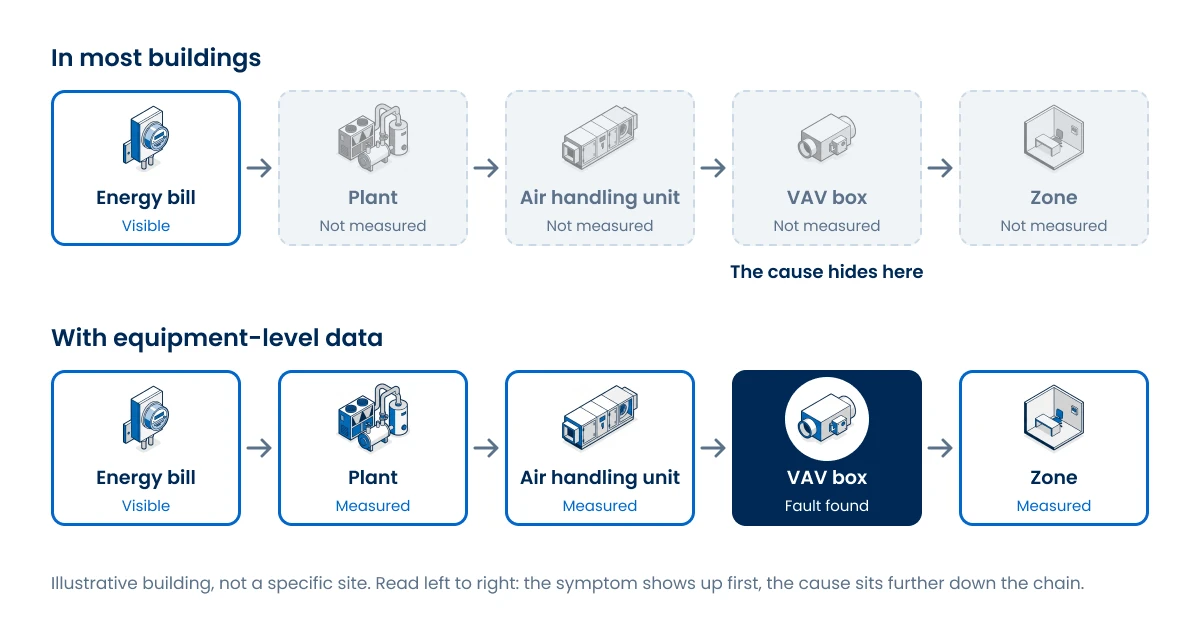
That is why so many faults present as "the bill crept up" rather than "equipment X is failing." The symptom is visible at the top. The cause hides three or four links down, in equipment nobody is monitoring.
Some failures announce themselves. A compressor that dies takes the cooling with it, and someone calls that morning. FDD exists for the faults that do not interrupt comfort at all:
None of these trip an alarm. All of them show up in the data, if the data exists.
The payback on FDD is large. Commercial buildings waste roughly 30% of the energy they use, an EPA estimate cited by the U.S. Department of Energy, and Lawrence Berkeley National Laboratory reports median whole-building energy savings of 9% from FDD software. Against that, FDD is one of the highest-return moves a building operator can make.
And yet most buildings do not run it. The reason is not exotic analytics. It is a hard prerequisite: equipment-level data. You cannot detect a fault in equipment you are not measuring, and you cannot diagnose it without data at each link in the chain. A conventional building automation system reaches roughly the top 20% of a building, so even where FDD exists, it watches the fraction of equipment already instrumented and stays blind to the rest. The faults in the other 80% stay invisible for the simplest reason: nothing is looking.
Put the pieces together and the requirements are concrete.
FDD is a data problem before it is a software problem. The algorithms have existed for years. What has been missing in most buildings is the measurement underneath them.
You do not need to instrument an entire portfolio to begin. A practical order:
Faults are not rare events in commercial buildings. They are a steady background cost that runs in equipment nobody watches and surfaces only as a bill that drifted up. FDD turns that drift into a specific, fixable finding, but only when the instrumentation exists to see it.
That is the layer E360 adds: wireless instrumentation across the equipment and down the chain a conventional system never reached. If your building's faults only ever show up on the bill, start by measuring the equipment they hide in.
FDD is two jobs in one name. Detection is noticing that a piece of equipment is not behaving the way it should. Diagnostics is figuring out why, and where, so someone can fix the right thing. Done well, FDD runs continuously against live equipment data, compares what each system is doing to what it should be doing under current conditions, and flags the gaps.
Most faults never interrupt comfort, and most buildings cannot see the equipment where the fault lives. A warm zone might trace back to the zone, the VAV box, the air handling unit, or the plant. Without data at each link, you can see that energy went up but not which link broke, so the fault shows up as an energy bill that crept up.
The faults that do not interrupt comfort at all: simultaneous heating and cooling, a stuck economizer damper, a failed or drifting sensor, short cycling, refrigerant loss and belt slip, and equipment running after hours because a schedule override was never cleared. None of them trip an alarm, but all of them show up in the data, if the data exists.
Lawrence Berkeley National Laboratory reports median whole-building energy savings of 9% from FDD software. For context, commercial buildings waste roughly 30% of the energy they use, according to an EPA estimate cited by the U.S. Department of Energy.
Not for most of the building. A conventional building automation system reaches roughly the top 20% of a building, so even where FDD exists, it watches only the equipment already instrumented and stays blind to the rest. The faults in the other 80% stay invisible because nothing is looking.
Equipment-level data at each link in the chain, from the zone to the VAV box to the air handling unit to the plant. That means instrumentation first, energy signatures and not just alarms, and diagnostics that trace the full chain, so a warm room points to the actual broken part instead of a work order for the wrong one.
Instrument the equipment most likely to hide faults, such as refrigeration, major HVAC, and anything that runs continuously. Start with detection, then add diagnosis as more of the chain gets instrumented. Then close the loop: tie each finding to maintenance, and measure the program by faults fixed rather than alerts raised.


We deliver innovative energy management, demand response, and building automation solutions to enterprise, manufacturing, industrial, healthcare, hospitality, K-12, and higher education sectors across the United States and globally.
©2026 InTech Energy, Inc. DBA Sanalife Energy. All rights reserved. Various trademarks held by their respective owners.