A building automation system (BAS) controls equipment, and a building management system (BMS) is usually the same thing with a wider scope. Energy monitoring measures what the building consumes, down to the circuit. Control and measurement are different jobs, and most buildings have the first without the second. If your equipment runs fine but your energy bills are a black box, the missing layer is monitoring, not more automation.
If you have sat through a facilities budget meeting lately, you have heard all three terms used as if they mean the same thing. A vendor pitches a "building management system." Your engineer calls it a "BAS." Someone in finance asks why the "energy monitoring" line item is separate. They are not synonyms. Treating them as one is how buildings end up paying for software that cannot fix the problem they implemented it to solve.
Here is what each one does, where they overlap, and which of the three your portfolio needs.
Control and measurement are different jobs, and the expensive mistake is assuming the system that runs your equipment also measures it. It usually does not, or only barely. Here is how the three terms split:

A BAS is the brain that operates the big equipment. A sensor reads a condition, the system compares it to a target, and it sends a command. That loop, sensor to setpoint to command, is the anatomy of all building control. Read the zone temperature, compare it to the setpoint, tell the variable air volume (VAV) box to open.
A BAS is very good at running the central plant: air handling units (AHUs), chillers, boilers, and the major rooftop units (RTUs). That is also where its reach ends. It was never designed to measure everything, so it instruments only the thin slice of equipment it can economically reach, roughly the 20% that sits on the major mechanical systems. It controls that equipment well and has little to say about the rest of the building.
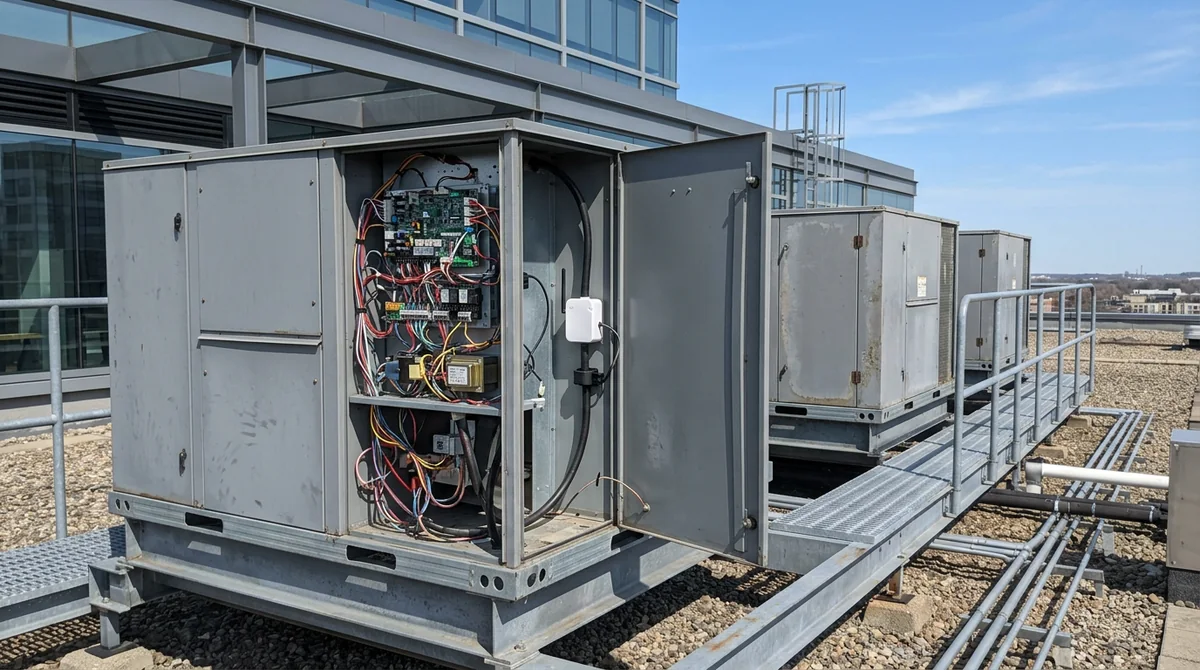
In day-to-day use, BMS and BAS are interchangeable. Where the terms diverge, "BMS" tends to describe a system with a wider remit: HVAC automation plus lighting, access, and fire and life-safety. Think of it as a BAS with more building subsystems hanging off the same supervisory platform.
For a buyer, the point is that a broader scope does not mean broader measurement. A BMS can supervise every one of those subsystems and still have no idea how many kilowatt-hours a specific tenant floor or refrigeration case draws. Scope of control is not depth of data.
Energy monitoring is the layer most buildings are missing. It answers "what is this using, and when," down to the circuit.
The idea behind it is the metering tree. The utility revenue meter sits at the root. Below it, submeters measure equipment and circuits: the main plant, a tenant floor, a bank of refrigeration cases, an EV charging deployment. Most buildings instrument only the root and infer everything below it. Real energy monitoring builds the tree out, so demand and consumption show up where decisions get made.
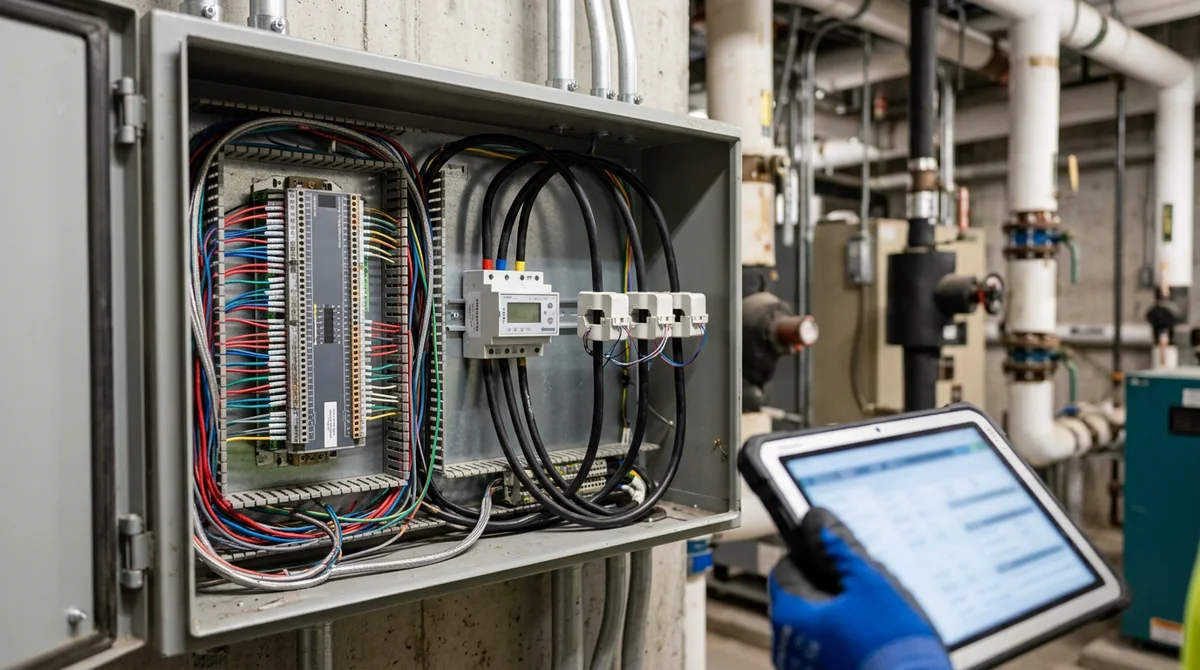
Those two words, demand and consumption, map to the two units everyone mixes up. Kilowatts (kW) measure power, a rate, and your demand charges bill on peak kW. Kilowatt-hours (kWh) measure energy, a quantity, the total consumed over time. A control system holding a setpoint does not need to track either with precision. An energy program lives or dies on both.
Here is how the three compare on the questions that matter when you are buying.
| Category | BAS | BMS | Energy Monitoring |
|---|---|---|---|
| Primary job | Control equipment | Control equipment, often more subsystems | Measure consumption |
| Core question it answers | Is the building at setpoint? | Are the building's systems running? | What is the building using, and where? |
| Typical scope | HVAC and central plant | HVAC plus lighting, access, life-safety | Circuit, equipment, and zone level |
| Unit it cares about | Setpoints and commands | Setpoints and commands | kW (demand) and kWh (consumption) |
| What it usually misses | Measurement beyond the main plant | Granular energy data | Equipment control, by design |
| Coverage of the building | ~20% of equipment | ~20% of equipment, more subsystems | The other 80%, once instrumented |
The cost shows up as waste. The EPA estimates that, on average, 30% of the energy used in commercial buildings is wasted, as cited by the U.S. Department of Energy, and commercial buildings account for about 37% of US electricity sales, according to the U.S. Energy Information Administration. That waste does not live in the equipment your BAS already runs and watches. It accumulates in the systems nobody measures: a refrigeration case holding temperature by brute force, a circuit drawing more than it should overnight, a VAV box fighting its neighbor. Those are faults, and they stay invisible without equipment-level data.
Fault detection and diagnostics (FDD) finds them by walking up the chain, from the zone to the VAV to the air handler to the plant, and you cannot walk a chain whose lower rungs were never instrumented. A BAS that controls the top 20% cannot see the faults hiding in the bottom 80%. That is a different job from the one the BAS was built for, and it needs a different layer.
Plenty of commercial buildings already have a BAS or BMS. For those, the question is rarely "should we buy automation." It is "can we see what the building is doing." You do not replace a BAS with energy monitoring. You add the measurement layer it was never built to provide, and the two work together: the BAS keeps running the equipment, and monitoring tells you what that equipment consumes and where it is failing.
A few ways to tell where you stand:
If your building has no BAS at all, you have a different starting point. Monitoring can come first, and automated controls can be deployed later with wireless IoT hardware.
Three-quarters of US commercial buildings were built before 2000 (EIA CBECS, 2018), long before granular monitoring was standard, and rewiring them is costly and disruptive for most owners. The practical path instruments the missing points without tearing the building apart: extending the metering tree wirelessly, down to the branch circuits, the refrigeration, and the zone.
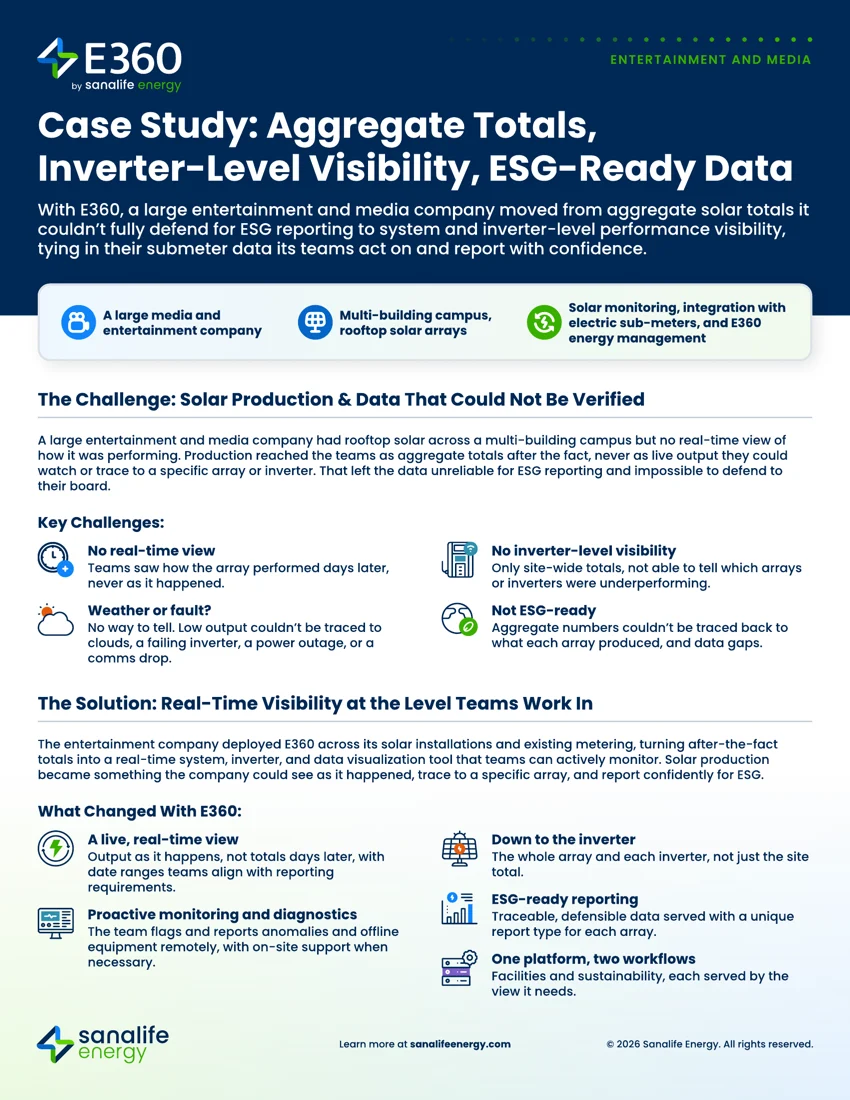
That is the layer E360 adds. The BAS runs your building. E360 shows you what it is doing, across the 80% the automation never reached. It can integrate with your BAS, layer on top of it, or work in tandem with it.
The best-managed buildings of the next decade will be the ones that can see their equipment, not just control it. If you can name your buildings' equipment but cannot say what any of it consumes, that is the gap to close first.


We deliver innovative energy management, demand response, and building automation solutions to enterprise, manufacturing, industrial, healthcare, hospitality, K-12, and higher education sectors across the United States and globally.
©2026 InTech Energy, Inc. DBA Sanalife Energy. All rights reserved. Various trademarks held by their respective owners.