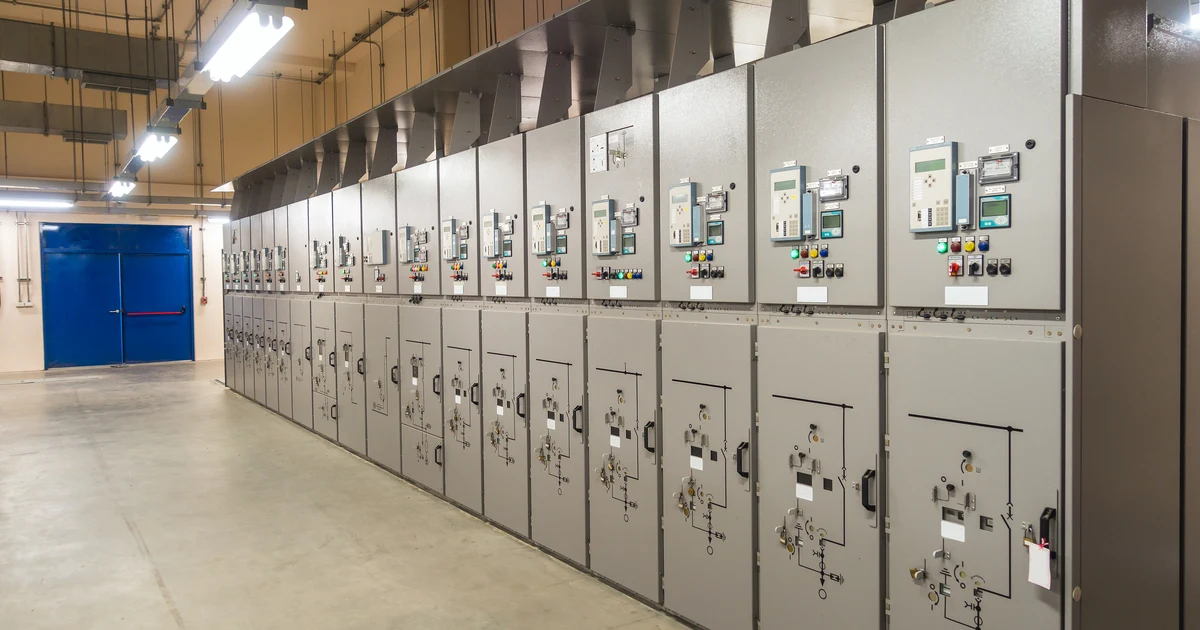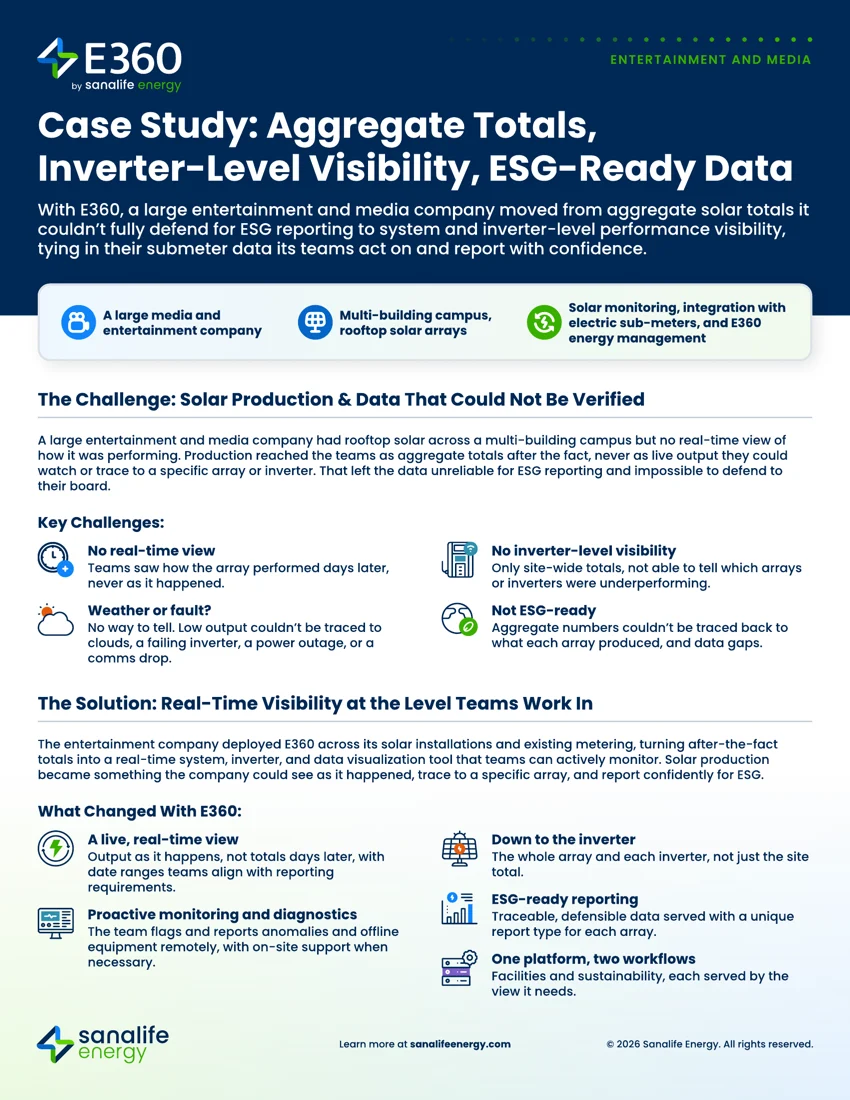
Most energy management systems demo well, so the demo rarely separates them. Start with coverage: every feature rests on data from the equipment, and a platform can only analyze what it measures. Then ask ten questions covering installation, granularity, data ownership, loads, portfolio roll-up, action, compliance reporting, security, and cost. Share real site details with each vendor before the demo so they can tailor it, and ask what share of your building they would measure.
Every energy management system demos well. Clean dashboards, animated charts, a rep pointing at a falling line and calling it the savings. Watch three in a row and they blur together. The platform that earns its place in your building is rarely the one with the prettiest interface. It is the one that can answer a specific set of questions, and most buyers never ask them.
Here is the checklist: one reframe, ten questions, and how to prepare so the demo you get is built around your building.
Almost every feature on an EMS spec sheet, alerts, fault detection, demand management, sustainability reporting, rests on one thing: data from the equipment. A platform can only analyze what it measures. So the question that predicts whether the rest of them deliver is not "what can the software do." It is "how much of my building will it see."
Put coverage at the top of the list. If a platform measures the utility meter and the main plant and calls it done, every downstream feature inherits that blind spot. Buildings waste roughly 30% of the energy they consume, an EPA estimate cited by the U.S. Department of Energy, and most of that waste hides in the equipment a shallow deployment never touches. Judge the data foundation first. Every feature is only as good as what feeds it.
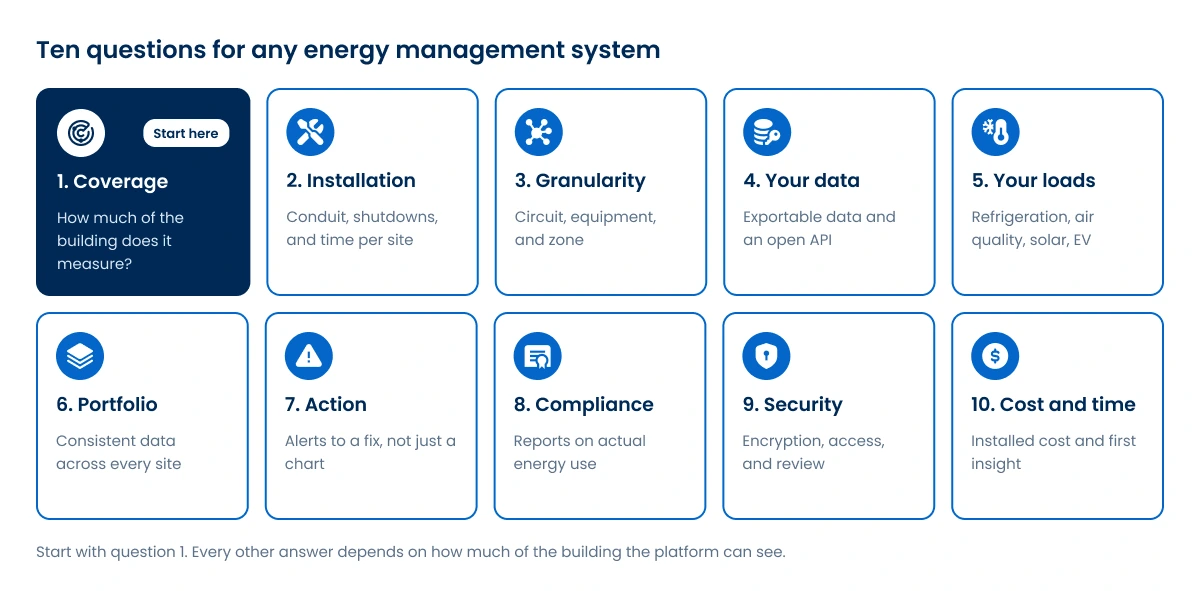
Ask: What share of my equipment and circuits will report data after install, not what the dashboard can display. Why it matters: A clean interface over a thin feed is still a thin feed. Coverage is the spec that governs every other one.
Ask: Conduit? Electrician shutdowns? How long per site, and how much disruption to tenants. Why it matters: Hardwired systems are slow and expensive to deploy, which is why so many stop at the main service. Wireless instrumentation skips the conduit runs, which changes what is economical to measure.
Ask: Can it measure at the circuit, the individual piece of equipment, and the zone, or only at the building and main-plant level? Why it matters: Allocation, fault detection, and capacity planning all need equipment-level granularity. Building-level data cannot tell you which load drove the peak.
Ask: Is the interval data exportable, and does the platform offer an open API and standard integrations? Why it matters: Your energy data should feed your other systems and outlive any one vendor relationship. A platform that traps your data is a platform you cannot leave, and cannot connect to anything else.
Ask: Can it meter the things your building actually runs: refrigeration, indoor air quality, solar and storage, EV charging, water, gas, steam? Why it matters: A platform built only for whole-building electricity will not help a grocery operator with refrigeration or a campus adding EV charging. Match the tool to your loads, not to a sample building.
Ask: Can it benchmark and report across every site on consistent, measured data, or does each building stand alone? Why it matters: If you run more than one building, portfolio-level comparison is where a lot of the value is. Stitching together separate accounts by hand is not a reporting system.
Ask: Beyond dashboards, what does it do: alerts, fault detection, measurement and verification, automated reports? Why it matters: A dashboard tells you what happened. The point of an energy management system is to change what happens next. Ask to see the workflow from a detected problem to a fix, not just the chart.
Ask: Can it report against actual energy consumption for benchmarking and the building performance standards you are subject to? Why it matters: A growing list of city and state standards require building owners to report actual energy use. If reporting is a reason you are buying, make the vendor show you the actual output.
Ask: How is data encrypted in transit and at rest, how is access controlled, and how often are security practices reviewed? Why it matters: You are putting operational data about your buildings into a platform. You are entitled to clear answers on how it is secured and who can see it. Get those answers in writing, and match them to your own organization's requirements.
Ask: Total installed cost per site, and how long until the first useful insight. Why it matters: A platform that takes months and a construction project to stand up has a very different payback than one that starts reporting data soon after install. Time to first insight is part of the price.
The most useful demo is one built around your site. Bring real details to the first meeting, so the vendor understands your use case and can show how the platform would serve it.
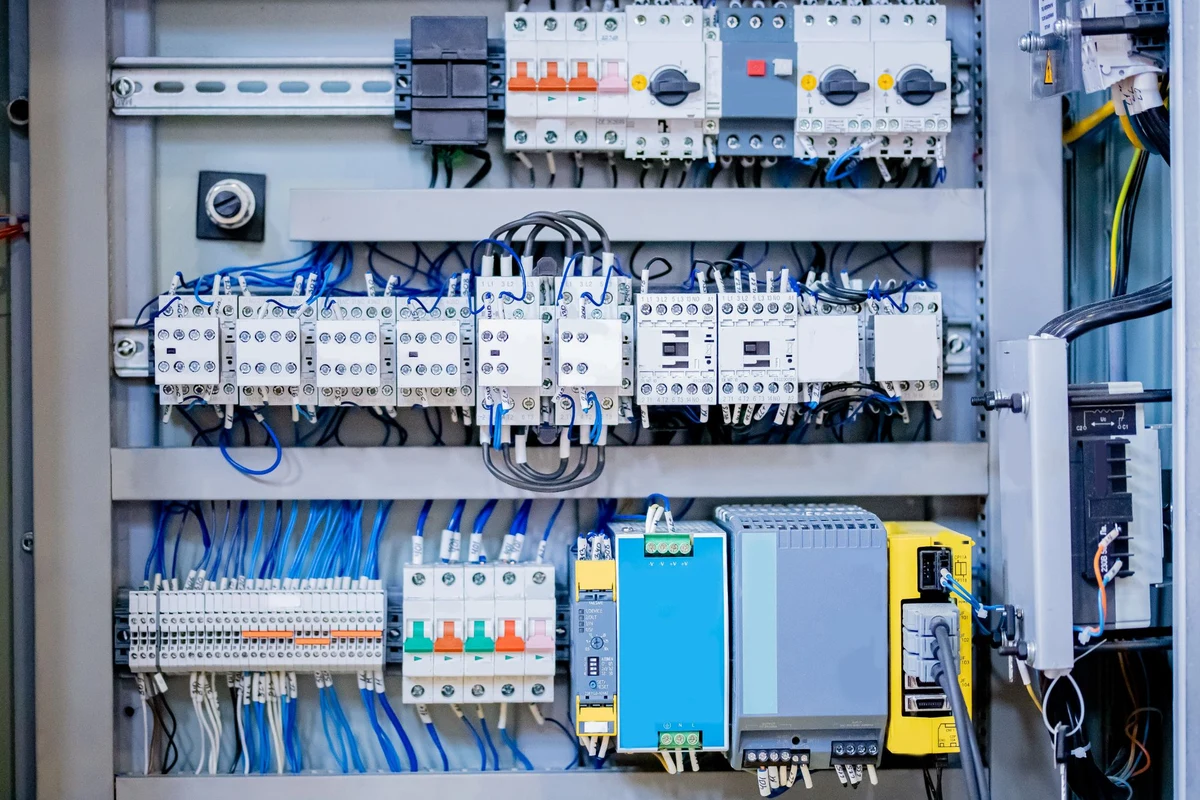
If you only remember one question from this list, make it the first one: how much of my building will this actually see? Coverage is the spec that decides whether every other feature delivers or disappoints, and it is the one most buyers never put on the table.
That is the layer E360 adds: wireless instrumentation across the equipment, circuits, and zones a conventional system never reached. If you are evaluating energy management systems, start by asking each one how much of your building it will measure. The answers will tell you most of what you need to know.


We deliver innovative energy management, demand response, and building automation solutions to enterprise, manufacturing, industrial, healthcare, hospitality, K-12, and higher education sectors across the United States and globally.
©2026 InTech Energy, Inc. DBA Sanalife Energy. All rights reserved. Various trademarks held by their respective owners.